Lecture – Tasks and Task Management
(Chapter 12)
Table of Contents
- Lecture – Tasks and Task Management
(Chapter 12)- Table of Contents
- References
- Vocabulary
- Task Scheduling
- CPU Utilization
- Scheduling Priority
- Blocking (resource-based blocking)
- Priority Inversion (indirect resource-based blocking through CPU priority blocking)
- More Vocab
- Scheduling of Tasks 12.4
- Time-shared Systems
- Rate monotonic scheduling (RMS)
- Priority Scheduling
- Real-time scheduling
- Scheduling Algorithm Performance Metrics
- Inter-task Communication (Book 12.6)
- Shared Variables
- Shared Buffers
- Ring or Circular Buffer
- Mailbox
- Messaging
- Message Buffering
- Access to Shared Resources
- Atomic Access Flags
- Solutions to Critical Section Problem
- Tokens and Token Passing
- Disabling Interrupts for Critical Sections
- Semaphores
- Mutual Exclusion and Mutex
- Process Synchronization
- Extending Semaphores
- Monitors
- Starvation and Deadlocks
- Deadlock (Don't Distribute)
- Deadlock
- Handling Deadlocks
- Deadlock Prevention -- Causes and Mitigation
- Deadlock Avoidance
- Deadlock Detection and Recovery
- Slide Fixes
References
- †James K. Peckol : Embedded Systems: A Contemporary Design Tool, Wiley https://www.wiley.com/en-us/Embedded+Systems%3A+A+Contemporary+Design+Tool%2C+2nd+Edition-p-9781119457558
- Specifically Book Chapter 12 and Chapter 13
Vocabulary
-
notes on vocabulary from reading
- absolute time -- real world time
- relative time -- time referenced to some event
- interval -- any slice of time characterized by start & end times
- duration -- distance in time between start and end times
- reactive systems -- has tasks triggered by evoking events
- time-based systems - has tasks triggered by evolution of time
- absolute time schedule -- actions are to be performed at specific time
- relative time schedule -- actions are to be performed before or after some reference event by a specified amount
- periodic task -- tasks with constant duration between initiation
- aperiodic -- not periodic
- jitter -- variation in time from expected or idea, for a periodic expectation it is the variation for that. Might be measured as worst-cast (e.g. worst case jitter, or standard deviation (RMS))
- delay -- time between the evoking event and start or completion of action
- execution time -- CPU time to complete a task
- hard deadline -- if action doesn't occur by some time system is considered to have failed
- hard real-time system -- has at least one task with hard-deadline, focus of design on hard-deadlines
- soft real-time -- usually system must meet deadline "on average" e.g. to
achieve an average throughout - firm real-time -- mix, of hard and soft deadlines
- predictability - how well we know the timing of tasks completing and
starting - inter-arrival time - time between evoking events, esp. for aperiodic
systems. Typically need to know bounds and/or average intervals
between events to know if system can meet demands
Task Scheduling
-
priority - allows some task to be designated to run before others
-
schedulable - in real-time context, refers to a task that can be scheduled (added to the queue) and will meet its timing constraints
-
deterministically schedulable - in a system, means that it has been determined (can be guaranteed in-advance) that a given task will always be able to be scheduled and meet have its timing constraints met
CPU Utilization
- CPU Utilization -- percentage (%) of time CPU is being used to complete tasks instead of being idle
- Typically 40 % - 90%
- Low utilization is an indication that perhaps resources and cost can be reduced
- High utilization indicates a level of risk for missing deadlines, depending on variability in the system and externally
- important state transition conditions are numbered in the diagram
- If may be forced by OS interruption and not just by the task self-yielding the CPU, the system is preemptive, otherwise it is non-preemptive
- With non-preemptive OS tasks stop executing when they give up the CPU by completing (->exit), put themselves in a wait queue such as for an I/O request or desired delay (->wait), or yield the CPU themselves (->ready). Looking at the task code, these happen at well-defined places.
- With preemptive OS tasks may be interrupted most places in the code
- Typically implemented with an interrupt
Preemptive OS
A preemptive OS can interrupt a running process and "involuntarily" have it moved to the ready queue before completion, whereas with a non-preemptive OS the process will only provide a mechanism to "voluntarily" yield the CPU or wait on a resource. In other words, the base cause for a process to leave the CPU in a non-preemptive OS can be found in the code, such as a yield or I/O call. The "involuntarily" interruption in a preemptive leverages hardware support associated with an interrupt.
Scheduling Priority
- Non-preemptive and preemptive: priority determines which task is selected when CPU becomes available
- Preemptive only: priority also determines if a running task should be suspended upon another task reaching the ready state.
- These concepts apply to CPU access, not access to (I/O) resources, unless otherwise stated
- You may assume that a higher-priority process can be given access to CPU first with preemption, but not steal or be choose first for I/O access
Blocking (resource-based blocking)
-
blocking is when one task indirectly blocks another by holding onto a needed resource
-
Example:
Assume Task A and B with- priority(A) > priority(B)
- both require resource R
- entry order is B, A
-
Example Sequence:
- B reserves access to R
- A enters and preempts B
- A runs until it needs access to R
- A must be suspended to resolve the problem to allow lower priority
- A must be suspended to resolve the problem to allow lower priority B to complete. At this time, B is blocking A
Priority Inversion (indirect resource-based blocking through CPU priority blocking)
-
Assume Tasks , , such that
-
priority( ) > priority( ) >priority( )
-
Tasks and require resource
-
Entry order is , ,
-
Example Execution Scenario:
- begins to run and reserves
- enters and preempts
- runs, requests
- is suspended to allow to run and eventually free
- enters and preempts before releases
- runs until completion ☆☆☆
- runs releasing
- is resumed, uses and completes
- is allowed to complete
☆☆☆ The priority inversion happens here.
- The higher priority TASK A waits.
- The scheduler took into account and handled CPU priority and resource blocking separately.
- C could have been given a higher priority to the CPU than B by the virtue of it blocking A to prevent this.
Illustration added below
At this point, B is holding the CPU while a higher-priority A cannot progress. Note that A and B do not depend on the same non-CPU resource.
Note
This course is more focused on basic understanding and awareness of problems and limitations with multi-tasking. You may study systematic identification of problems and mitigation in other courses.
More Vocab
- turnaround time - the interval from the submission of a task to task completion
- throughput - # of process completed per unit of time
- response time - time delay from submission to the first action of task
- waiting time - the time spent in "waiting" queues
Example Task Queues that could be implemented:
- entry queue - has the tasks submitted but not yet ready to run
- ready queue - has tasks ready to run when CPU is available
- I/O queue - has tasks waiting on I/0
- device queue - has tasks waiting for access to a particular I/O device
Scheduling of Tasks 12.4
-
Asynchronous, Interrupt Driven
-
main program is a trivial infinite loop
-
tasks are initiated by interrupts
-
when there are no interrupts, the system does nothing
-
the CPU can wait in a low-power sleep mode waiting for events (see microcontroller documentation for availability of sleep features and details of usage)
-
CODE OUTLINE:
/* global variable declaration */

/* ISR setup */

/* function prototypes */

/* main program */
void main(void){
  /*local variable declarations*/

  /*call setup functions and initialize system*/

  /*enable interrupts*/

  while (1){
  /* no main work */
  /* goto sleep */
  };

}

/* ISR definitions */

/* Function definitions */
-
It is difficult to analyze (debug, evaluate, simulate, etc...) since it is based on external events.
-
-
Continuous Polling and Timed Polling
-
Software polls signals and dispatches tasks (function calls)
-
CPU is utilized more since it must check signals
-
can add pauses to "align" events to steps of time (or sleep to save power)
// global variable declaration

// function prototypes

void main(void){
    // local variable declarations
    while (1){ //task loop
      /* can add pauses/waiting here if desired
        * sleep with wakeup on timer event
        * resume
      */

      /* test state of each poll signal an if, then,or switch construct to initiate tasks */

    }
}


/* function definitions */
-
more predictable timing
-
easer to analyze
-
-
State-Based
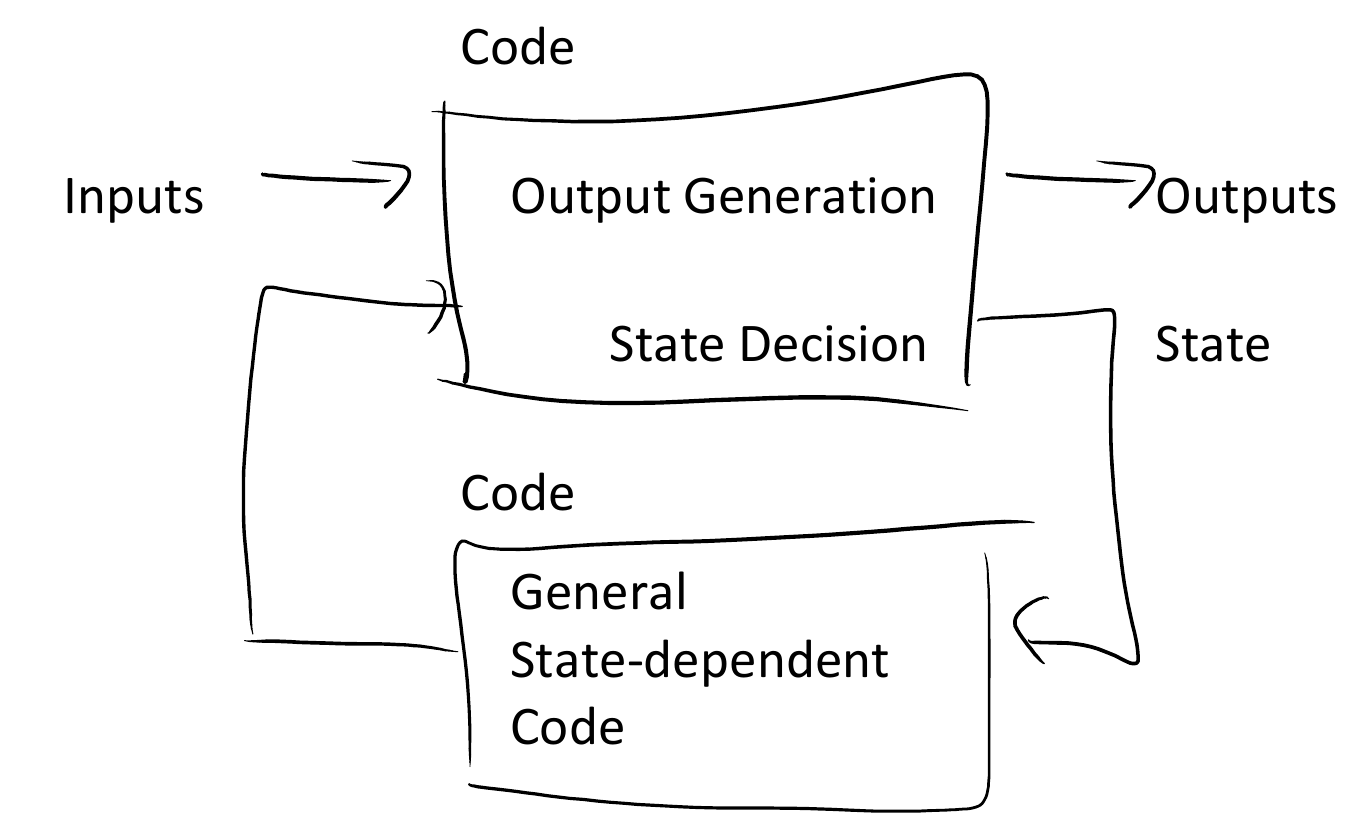
- Scheduler implements a state-machine
- In the previous systems, the there is a simple, time-invariant association of events to the tasks evoked
- In the state-based approach, tasks are dispatched based on FSM
- Varying response to events
- Can be difficult to meaningfully handle complex systems with one underlying state-machine as there may be too many states
-
Synchronous Interrupt Event Driven
- Like async.-event-driven, but instead events are derived from timers
- Timer triggers ISR to dispatch appropriate tasks
-
Combined Interrupt Driven
- Allow context switch on regular timer events AND asynchronous input events.
-
Foreground-Background
- Mix of interrupt-driven and non-interrupt-driven tasks.
- Interrupts signal foreground tasks while background tasks run
- Main loop implements background tasks in-between handling of interrupts
- ISRs should handle short immediate tasks
Time-shared Systems
- Divvy CPU time to multiple tasks
- first come -first serve (non preemptive)
- task taken from front of queue and runs to completion
- not-preemptive, probably not suitable for real-time systems
- shortest job first
- each task has an associated expected CPU time before completion
- non-preemptive variant: tasks finish and shortest next one is selected
- preemptive variant: if current task has longer to complete than another task it may be suspended
- round robin
- blocks of time called time quantum or time slices are allocated in a "circular" pattern to tasks
- task that don't finish in give slice are suspended and moved to back of queue
- first come -first serve (non preemptive)
Rate monotonic scheduling (RMS)
-
For periodic release of tasks, with deadline one period after release
-
preemption at any time
-
will allow more frequent tasks to have priority
-
schedulability test for RMS (https://en.wikipedia.org/wiki/Rate-monotonic_scheduling)
- is the utilization factor
- is the number of tasks
- is each task's compute time, in practice can use worse case for each given task (longest)
- is each task's period of release with the deadline being one period later, in practice can use worse case for each given task (smallest interval)
-
Critical Zone Theorem: If the computed utilization is less than the utilization bound, then the system is guaranteed to meet all task deadlines is all task orderings
-
for n=2, the utilization factor should be approximately less than 83%
-
for n=10, the utilization factor should be approximately less than 70%
-
for ,
Must adjust for blocking
Priority Scheduling
- allow scheduling dependent on priority of task
- Example already seen: "shortest job first"
- With priority scheduling there can be issues:
- indefinite blocking, priority inversion, starvation (some tasks
never get a chance to run in a reasonable time, causing severe delays)
- indefinite blocking, priority inversion, starvation (some tasks
- Tasks can be prioritized based on
- execution time
- deadline
- laxity : defined as
- criticality
- implement two queues:
- critical has hard deadlines and uses RMS
- non-critical does not have hard-deadlines and runs when processor is not running critical tasks
- implement two queues:
Real-time scheduling
- hard-real time -- scheduler accepts tasks it knows it can complete in a given time
- requires advance information about tasks such as execution time and I/O resources required so that reservations for resources can be made
- works with I/O devices with well-defined timing
- soft-real time
- focuses on prioritization and low-latency dispatch, usually requiring preemption
Scheduling Algorithm Performance Metrics
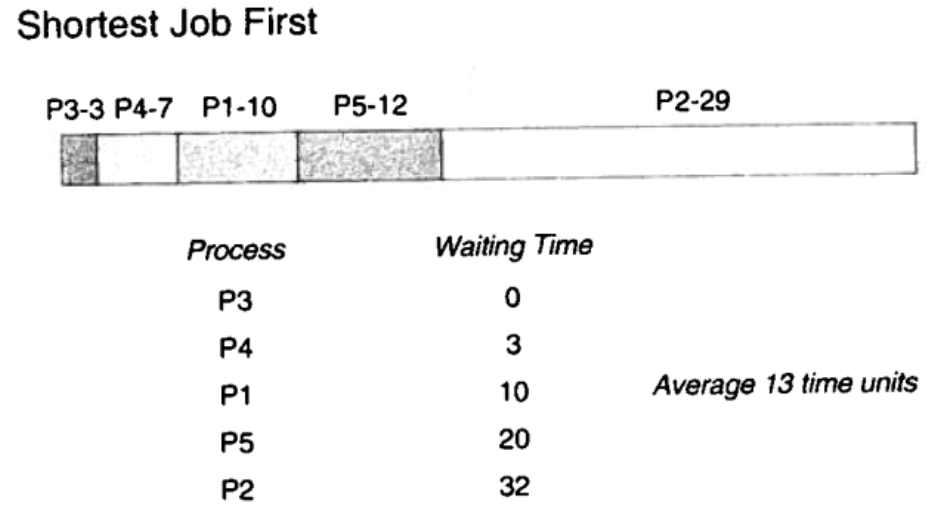
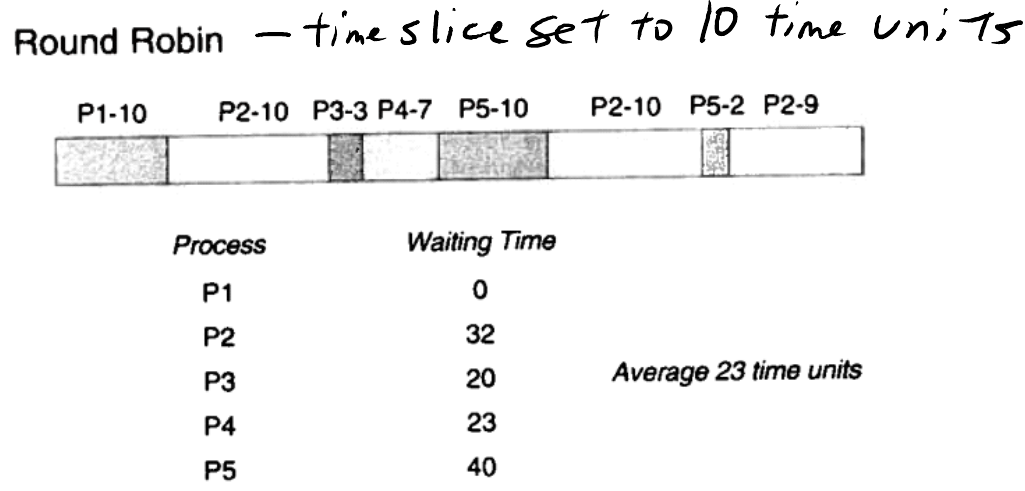
Common to look at metrics such as average wait time or average process-completion throughput
Book Example:
5 processes queued at the same time
| Process | CPU Time Required |
|---|---|
| P1 | 10 |
| P2 | 29 |
| P3 | 3 |
| P4 | 7 |
| P5 | 12 |
- First-Come-First-Serve

- Shortest Job First
- Round-Robin
Inter-task Communication (Book 12.6)
- considerations:
- what data is to be shared
- where is it stored
- how to coordinate the usage between two processes
- Examples of data to share:
- a number
- an array
- status about a resource
- synchronization signals to facilitate coordination
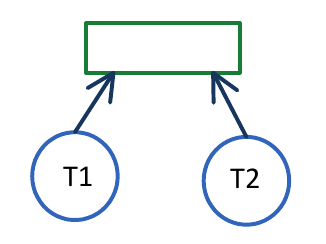
Shared Variables
- global variables
- need to coordinate access
- efficient for space and speed, important in embedded systems
Shared Buffers
- can be a stack, FIFO queue, or other buffer type
- producers place data in the buffer and consumers access and remove the data
- need methods to coordinate, like functions IsFull() and IsEmpty()
- overrun is when a producer fills a buffer faster than a
- consumer(s) remove it to the point where the buffer fills and can't accept incoming data without losing data
- underrun is when a consumer is left without any data...can be an indication of inefficient design (such as buffer that is not really required) , but it isn't a show-stopper in and of itself

Ring or Circular Buffer
-
A ring buffer is created using a block of memory and two pointers, the head pointer
-
and the tail pointer. Data is written at the head and the head pointer is advanced.
-
Data is read from the tail and the tail pointer is advanced.
-
When the pointers reach the end of the physical array, the will "advance" to the start of the physical array.
-
When the head pointer catches up with the tail, the buffer is full.
-
When the tail pointer catches up with the head, the buffer is empty
-
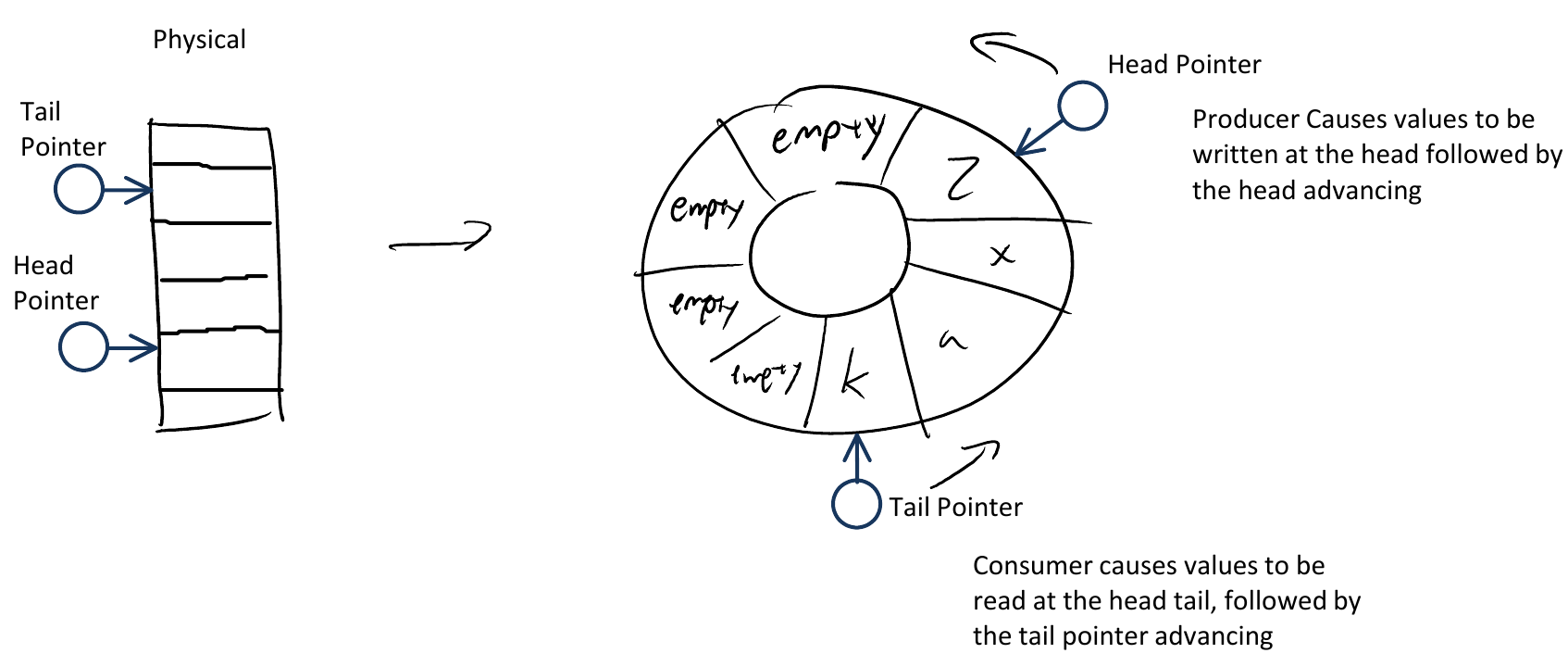
-
Head Pointer: Producer Causes values to be written at the head followed by the head advancing
-
Tail Pointer: Consumer causes values to be read at the head tail, followed by the tail pointer advancing
-
need to consider underflow and overflow
-
should (must) provide IsEmpty() and IsFull() so that processes can query the buffer and respond accordingly
Depiction of Length-24 and Length-3 circular buffer

Example Length-3 Implementation
Initially empty array, with writePtr and readPtr at the same location
Put: write 3
Put: write 5
Get: read returning 3
Put: write 7, writePtr wraps around to begining of allocated block
Put: write 11, writePrt becomes same as readPtr defining onset of Queue Full
Get: returns 5
Get: returns 7, readPtr pointer wraps around to begining of allocated block
Get: returns 11, readPtr becomes same as writePtr defining onset of Queue Empty
- In this depicted implementation, when the read pointer "catches up" with the write pointer, the array is empty.
- When the write pointer catches up with the read pointer the array is full.
- Note that the unused contents may be left in memory
Mailbox
- Mailbox constructs are provided by a full-featured OS.
- A mailbox can have a message (data) posted to it by another process
- A process can signal that it is waiting for a message (data) in the mailbox and, if nothing is available in the mailbox, it can be suspended until a message shows up
- Typical Code Interface:
pend (mailbox, data)
post (mailbox, data)
Messaging
-
Mailbox concept can be expanded, for instance, to support buffers or communication among devices on a board or larger network. General message boxes can be read and posted to by multiple processes.
-
Direct Communication - sender identifiers receiver and receiver identifies sender, or at lease sender identifies receiver
- effectively a communication channel between every pair of processes
send (T1, message) //send message to task T1
retrieve (T0, message) //receive message from T0
-
Indirect communication
senders and receivers identify a mailboxsend (M0, message) receive(M0, message)
Message Buffering
one consideration is if link guarantees message order regarding capacity
there are 3 options for buffering:
-
zero-capacity link
- sender waits on receiver (so order is certain)
- execution timing tied together
-
bounded-capacity link
- sender may burst data, but can only send if buffer not full
- receiver must match sender rate "on average" unbounded
-
infinite capacity
- sender can always post no waiting
- requires infinite storage or be sure that receiver removes data quickly enough
note book figures, including Figure 12.23
Access to Shared Resources
-
example using a shared buffer B0
Producer T0
int in = 0;
while(1){
  while(count == MAXSIZE);
  B0[in] = nextT0;
  in = (in+1) % MAXSIZE;
  count /*interrupt here*/ = count+1;
}
Consumer T1
  int out = 0;
  while(1){
    while(count == 0);
    nextT1 = B0[out];
    out = (out+1) % MAXSIZE;
    count=count-1;
}
-
count: read-and-modify operations should be atomic, executing from start to finished without interruption
-
what happens if count = count + 1 is interrupted between the read and the write so that T1 runs?
-
count = count + 1is a critical section of code
Atomic Access Flags
- once the critical section of code has been identified, it can be protected with statements that
- check and flag use of resource, entry section
- flag the release of the resource, exit section
-
Producer T0
int in = 0;
 while(1){
 while(count == MAXSIZE);
 B0[in] = nextT0;
 in = (in+1) % MAXSIZE;
 await(!T1Flag){ //**
   T0Flag = true; //**
 }
 count++;
 T0Flag = false; //**
 }
Consumer T1
 int out = 0;
 while(1){
 while(count == 0);
 nextT1 = B0[out];
 out = (out+1) % MAXSIZE;
 await(!T0Flag){ //**
   T1Flag = true; //**
 }
 count--;
 T1Flag = false; //**
 }
-
This approach that while awaiting a condition to become true, other processes can run that will allow the condition to become true, otherwise there is a deadlock
Solutions to Critical Section Problem
...must satisfy:
- must ensure mutual exclusion in the critical region, only one task at a time can be in the critical section of code
- prevent deadlock if two tasks are trying to enter their critical section at the same time, at least one task should be able to enter its critical section
- ensure ability to progress into critical section: if no other Task is in its Critical section, only tasks in
the exit section should have influence to affect entry - bounded waiting - should limit the number of times a low priority task can be blocked by higher priority processes
Tokens and Token Passing
- This approach uses a conceptual tokens that must be held to access a resource
- Before accessing a resource a process must "acquire a token"
- token is represented by some flag or variable
- token is passed directly from task to task; initiated by task, not OS
- Problems / Challenges:
- some task holds token forever
- task with token crashes (never frees/passes token)
- token is lost (such as in communication problem)
- process with token exits without passing token
- managing queue of process to receive token
- Solution
- system-level token manager that can recall and issue new tokens after time expires
- Overall, tokens require a lot of communication and overhead
Disabling Interrupts for Critical Sections
- processes can disable interrupts during critical sections and prevent preempting
- a process that hangs in critical section can cause problems... like token passing problem
- a solution is to disable interrupts below some priority level, allowing a time-out interrupt to recover the system, e.g. a watch-dog timer
- does not address problems sharing resources among processes running on different processors
Semaphores
-
concept:
- use a variable (s) to signal the locking of a resource
- simplest version involves a binary variable accessed through two ATOMIC Functions
-
s is initialized to false in the system
-
wait: atomic test and set
wait(s){
  while(s);
  s = true;
}
-
signal: clear
signal(s){
  s = false;
}
-
Every task has critical sections surrounded by
waitandsignal -
First task to reach critical section can block the other:
Task T0
{
  ...
  wait(s)
  critical section
  signal(s)
  ...
}
Task T1
{
...
wait(s)
critical section
signal(s)
...
}
Mutual Exclusion and Mutex
-
The use of a binary semaphore can be used for achieving mutual exclusion for access to a resource.
-
The binary semaphore used as a mutex (short for mutual exclusion)
-
Task T0
{
  ...
  wait(s)
  update database
  signal(s)
  ...
}
Task T1
{
...
wait(s)
update database
signal(s)
...
}
Process Synchronization
Aside from managing access to resources, semaphores can
also be used to synchronize processes
-
Task T0
{
...
get input from user
and put in a buffer
signal(sync)
...
}
Task T1
{
...
wait(sync)
process user data
in the buffer
...
}
Extending Semaphores
-
rather than have a process in a "spin lock" where it uses CPU cycles to check the synchronization signal until the instant the lock is gone, you could sacrifice response time and free the CPU by suspending the process and putting it in an (OS-managed) queue to be woken when another process calls the signal function
-
semaphores can take on more than a binary value; this is useful for managing a pool of identical recourses and multiple processes accessing them
-
Example of both, counting semaphore with blocking:
-
wait
wait(s){
  s=s+1;
  if (s>POOLSIZE){
    ~~add this process to waiting queue
    block(); //suspends process ** provided by os
  }
}
-
signal
signal(s){
  s=s-1;
  if (s>POOLSIZE){
    ~~remove some process p from waiting queue
    wakeup(p); //resumes process ** provided by os
  }
}
Monitors
- Semaphores represent a fundamental, low-level mechanism for resource locking and process synchronization.
- In general, tasks can use semaphores or you can write a "library" to access a particular resource that itself utilizes semaphores.
- For instance, imagine if a write command had a semaphore built into it to implement write blocking to prevent more than one process from writing at the same
time. - Section 12.10 of the text discusses Monitors, another abstraction whereby access to a resource such as a buffer is managed by a abstract data structure with a public interface (functions) to access the resource and allow process sleeping and resuming based on conditions.
Starvation and Deadlocks
- You must be aware of starvation and deadlocks when using semaphores.
- Starvation is when a process never has an opportunity to run and complete (or has to wait a very long time). This can be caused by Last-In-First-Out (LIFO) queues (a.k.a. stack).
- Deadlocks occur when a series of locks can be set up that prevent tasks from ever completing.
Deadlock (Don't Distribute)
Mutual Exclusion - once a process has been allocated a resource, it has exclusive access to it (that’s a given here)
No Preemption - resources can not be preempted
Hold and Wait - some processes are holding one resource and waiting on another resource (forever if required)
Circular Wait - a set of processes exists in a state such that each process is waiting on a resource held by another in that set (of course)
Deadlock
Necessary conditions:
-
Mutual Exclusion - once a process has been allocated a resource, it has exclusive access to it
-
No Preemption - resources can not be preempted
-
Hold and Wait - some processes are holding one resource and waiting on another resource
-
Circular Wait - a set of processes exists in a state such that each process is waiting on a resource held by another in that set
-
Example:
-
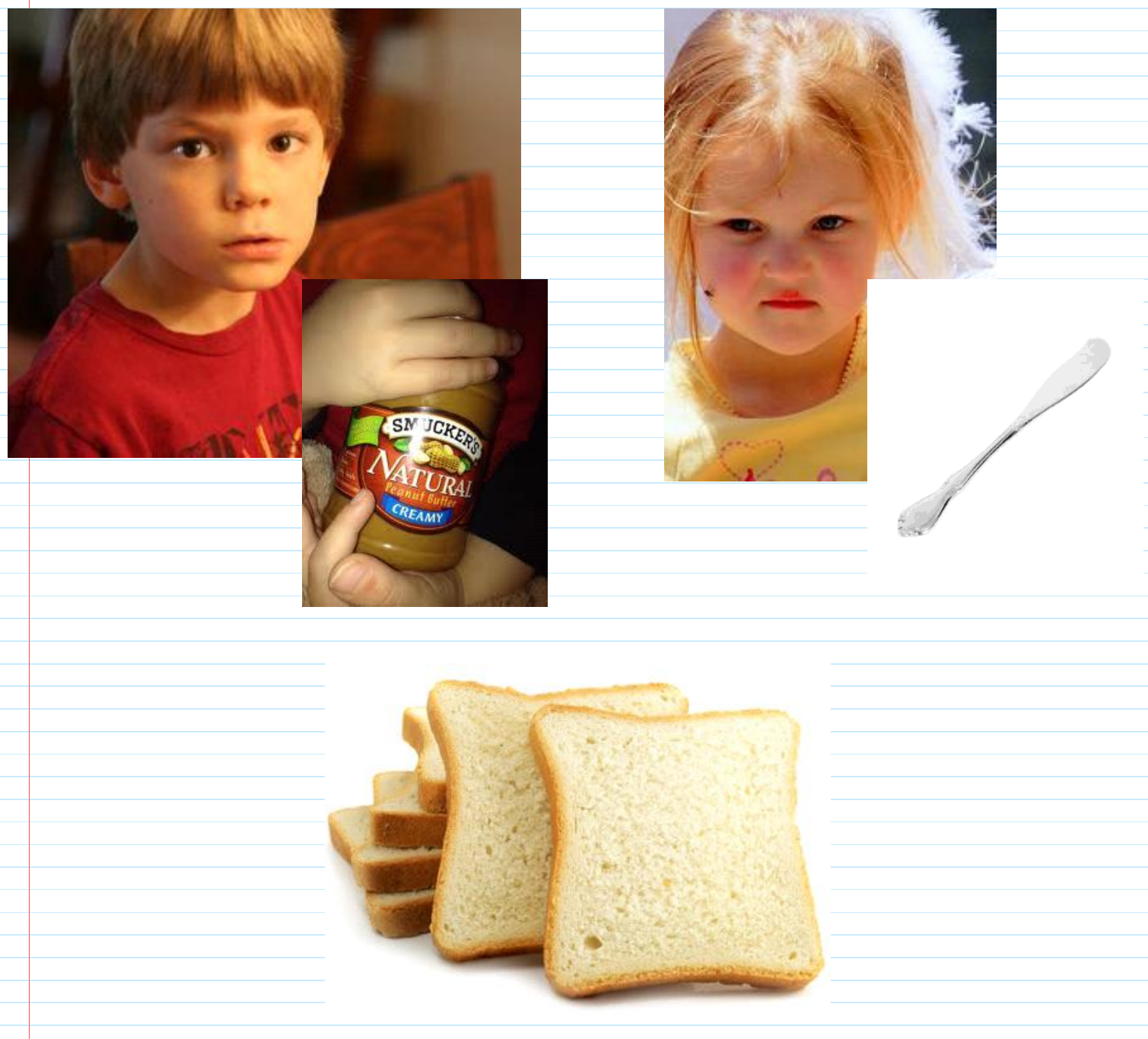
To make a peanut butter sandwich, bread, PB, and knife are needed. Assume two uncooperative children Suzy and Jonny run to the kitchen: Jonny grabs the PB and Suzy grabs the knife.
-
Example:
- variables representing back accounts actA and actB
- T0 wants to initiate a transfer, so it reserves access to actA
- T0 is suspended
- T1 wants to initiate a transfer from actB to actA, so reserves access to actB and waits for access to actA then suspends
- T0 resumes and waits for access to actB
Handling Deadlocks
- Two basic ideas:
- Deadlock prevention - OS can monitor a deadlock condition or conditions and prevent at least one of them (prevent little Jonny from grabbing the PB)
- Deadlock avoidance - the OS can be given information about resources required by the task and delay tasks that may cause deadlocks. A hard real-time system requires this information. (tell little Suzy to keep watching TV rather than be allowed in the kitchen)
Deadlock Prevention -- Causes and Mitigation
- Mutual Exclusion
- avoid locking access where not required. Example: though a buffer may not be written by more than one process, read access may be shareable
- Hold and Wait
- don't allow processes to wait for resources if it already has some reserved. This requires a process to wait for and reserve all required resources to be available at once. Also, if a process requires an additional resource, it must first free all of its resources without condition. This may lead to low resource utilization and starvation of low-priority tasks.
- No preemption
- allow preemption.
- Any process that hold resources and requests another that is not available must allow its resources to be freed and if this happens a list of required resources is created and the process will resume when all of them are available ...unless that resource being requested is held by another process that is itself waiting on other resources, in that case force that other waiting process to give up the resources.
- Circular Wait
- assign an order to all resources and enforce that no resources may wait on a higher- numbered resource while holding a lower numbered resource while order for requests. This requires requesting resources in-order and/or free resources lower-number resources when requesting a higher-numbered resource.
- In bank example, imagine if T1 waited for actA before asking for actB
Deadlock Avoidance
- Details given in 13.7 and in OS course. The basic idea is that process must inform the OS of what resources it potentially needs to execute a task. The OS then makes decisions about which processes may safely be allowed to continue and what order would be most efficient.
Deadlock Detection and Recovery
- If no prevention or avoidance is provided, deadlock detection and deadlock recovery must exist.
- OS must maintain a model of allocated resources and pending waits.
Wait-for Graph:
- Arrow from resource to task indicates resource reserved by task
- Arrow from task to resource indicates task waiting for resource
- Conventionally, the resources are removed for simplicity of representation
Deadlock:
Recovery
Once a deadlock is detected, the processes can be collectively or selectively terminated or have their
resources preempted. This is not simple since preempting resources or terminating processes can leave resources in dangerous sates. Mechanisms for allowing safe preemption or repair should be considered. The assumption is that terminating a process only requires it to restart its work resulting in wasted time (which can drive selection of what process should be terminated to waste as little time as possible). One should consider allowing for recovery points (checkpoints) in long tasks that may be terminated...like autosave in a wordprocessor. Recovery should not cause the deadlock to be repeated and should not starve processes.
Slide Fixes
2022-08: Extending Semaphores: have a ~~of~~ process ... ~~look~~ ++lock++ is gone